

Three Way
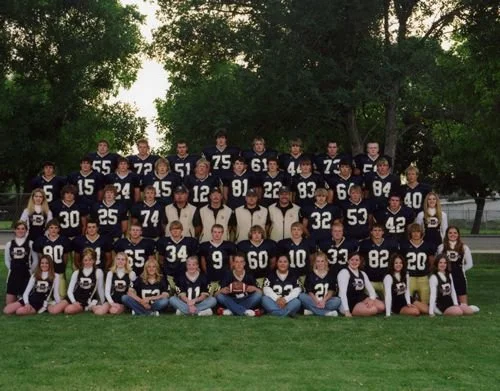
Junior year is an interesting time in your life and high school career.
You're an upperclassman. You've got two years of high school under your belt. You're heading toward adulthood, but...
You're still a kid.
In 2004, I was a junior at Beaverhead County High School (BCHS) in Dillon, Montana.
And it was time for football again.
The year before, as a sophomore, I'd been part of a Varsity team that went 11-0, won the Southwest Conference, and eventually won the State Championship.
At the same time, I was also part of a Froshmore developmental team that went 2-6.
Two very different experiences happening simultaneously.
The 2003 Varsity team had some of the best players to ever come through the BCHS football program, and we graduated 15 seniors from that team.
The junior class from '03—now our seniors—was already a dwindling group. A lot of kids from that class were more interested in partying than playing sports, leaving us with a relatively small senior class of 8 players.
That meant the majority of the 2004 team would be juniors —16 of us in total— with 8 already having some Varsity experience.
The sophomore class, 8 players in total, was talented too and included our new starting quarterback, Zach McRae, who today is the Head Coach of the Dillon Beavers.
Zach had some enormous shoes to fill.
Our previous quarterback, Torrey Thomas, had started on Varsity for four years, three of them as QB1, and had just moved on to play safety at the University of Montana.
We also brought three freshmen up to Varsity, with a few others sprinkled in throughout the season when needed.
Needless to say...
We had some BIG shoes to fill.
The Dillon Beavers football team had gone 19-1 over the previous two seasons.
That creates expectations.
But with such a young team, 2004 was going to be about trying to compete while developing at the same time.
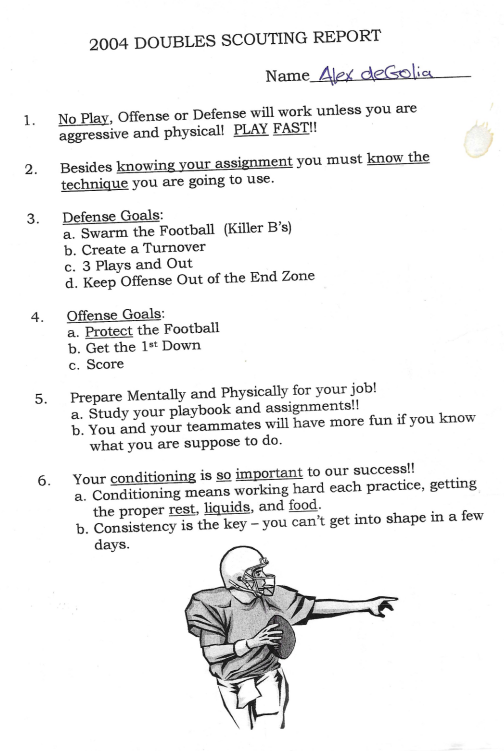
Early in the season, I remember Head Coach Terry Thomas telling us:
"You can lose a game and still be successful."
That was a new concept to me.
His point was that if you're learning, progressing, honing your skills and, above all, giving everything you have, then that's enough.
The scoreboard matters.
But it's not always the whole story.
Looking back, I think the coaching staff was establishing expectations and the mindset we'd need for the 2004 season.
2003 had been championship or bust.
2004 wasn't one of those years.
Deep down, I think we all knew it.
Our senior class lacked some of the leadership we'd had the year before, and the younger classes were going to have to carry a significant portion of the load while still learning how to do it.
Between our developmental seasons, the combination of the 2002 seniors and juniors had gone 3-6, while our 2003 juniors and sophomores went 2-6.
Collectively, those groups went 5-12.
Now, don't misunderstand what those Froshmore seasons were about. Winning was great, but the real purpose was learning the system and culture, translating it onto the field, and getting reps.
Our class took full advantage of those seasons.
Still, we entered 2004 with high expectations.
And in hindsight, we were probably taking some of the program's recent success for granted.
3-0
Week 1, we squeaked out a 21-20 win over Bigfork at home.
The Vikings scored late to pull within one and went for two and the win.
They didn't get it.
Week 2, we headed to Laurel and beat a team that had ended Dillon's 2002 season on our home field in double overtime of the State Quarterfinals—the Beavers' only loss over the previous two years.
Revenge felt good.
Week 3, we beat up on Livingston, my birthplace, and suddenly this supposedly rebuilding team was 3-0.
We were young, but we were cohesive.
The system worked.
The culture worked.
And for a while, it looked like we might just keep rolling.
During practice that week, I rolled my ankle during our Monday postgame "1,000-yard club" conditioning—100-yard sprints totaling 1,000 yards.
I was hobbled, but I still managed to make a couple of catches in the Livingston game.
Offensively, I was part of a deep receiving group.
Chance Plutt had contributed during the 2003 State Championship run and was now a starter as a junior. Seniors John Ori and Cory Anderson had also contributed the year before and were veteran locks for two more starting spots.
That left one of four starting receiver positions in our spread, no-huddle offense.
And a bunch of us wanted it.
Eventually, Kris Keller and I rotated starts and series.
Funny enough, every game I started happened to be on the road. I wouldn't hear my name announced as a home starter until my senior year.
I appreciated the reps, but the rotation made it difficult for me to find a rhythm.
More importantly, I started putting an enormous amount of pressure on myself to perform.
That led to overthinking.
And overthinking led to drops.
One time, Denny Nesbitt—the late father of my teammate Jordan "Shorty" Nesbitt—gave me an assessment I'll never forget.
Shorty had been a starter on the 2003 team. As a younger player, one of my game duties was keeping track of his defensive gloves—the infamous ColdGear Neumanns. I'd hold them while he played offense and have them ready when he switched to defense and wanted something different from the lighter, sticky receiver gloves.
One day Denny looked at me and said:
"You know, you'd be a pretty good receiver. You just have to get rid of those bricks for hands."
That one cut deep.
Mostly because...
He wasn't wrong.
I was just so damn far inside my own head.
Defense came more naturally to me.
At cornerback, the thinking and pressure felt different. The position fit my game better: leverage, reaction, toughness.
And on offense, I found another way to contribute.
Blocking.
I took pride in getting my nose dirty in the running game. I liked mixing it up with bigger players. I liked the physicality.
Most of all, I could always control my effort.
The First Loss
Our first real test came on the road against Polson.
They were good.
And the difference showed.
The Pirates beat us 40-18, dropping us to 3-1 and giving Dillon its first loss since 2002.
We regrouped heading into conference play and beat Anaconda 33-16.
Now 4-1 overall and 1-0 in conference.
That game also gave me one of those seemingly insignificant moments that somehow sticks with you for life.
I was getting some late-game reps at cornerback.
We were in Cover 3. I dropped deep into my zone, and for whatever reason, the quarterback threw the ball...
Straight to me.
No receiver around.
A gift.
Interception.
...Except I dropped it.
Straight through my arms and off my chest.
"Breast cancer," as DB Coach Steve Vezina called those.
I was embarrassed.
But what I dreaded even more was Monday's lunchtime film session.
Coach Thomas preached something constantly:
Don't make excuses.
If you make a mistake, own it.
I'd heard teammates make excuses during film before.
"Ohhh, I rolled my ankle right there..."
"I thought..."
"I was trying to..."
Coach would pause.
"Okep."
Then he'd teach for a few seconds and move on.
But everyone in the room knew.
He knew it was bullshit.
So when my dropped interception came onto the screen and Coach asked:
"Alex, what happened here?"
I had a choice.
I said:
"Coach, I just dropped it."
The room erupted in laughter.
Coach immediately interrupted them.
"Did you hear that? He just dropped it."
And we moved on.
I've carried that tiny moment with me ever since.
Personally. Professionally. Everywhere.
Tell the truth.
Own your mistake.
It clears the air.
Instead of wasting everyone's time figuring out what actually happened, you can immediately start figuring out what happens next.
A Season of Hard Lessons
What happened next was a mishap that would help define our season.
Heading into Corvallis, Defensive Coordinator Rick Nordhal was dealing with health issues and wasn't part of our normal week of preparation.
He wasn't at the game either.
It affected our flow.
We came out flat. Corvallis hung around and eventually went ahead late.
We lost 35-28.
Just like that, we were 4-2 overall and 1-1 in conference.
It felt like a game we'd simply let get away.
The next week, we regrouped and beat Hamilton 21-9 to move to 5-2 and 2-1 in conference.
It was a critical win that kept our playoff hopes alive.
But personally, I learned another hard lesson.
I had been rotating series at cornerback.
The instructions weren't clear to me, and I didn't realize the rotation was supposed to continue for the entire game.
During the third quarter, we recovered a fumble.
Coach Nordhal turned to me.
"Were you in on that series?"
Not understanding what he was really asking, I started:
"No...I—"
He immediately cut me off.
"Viz, Alex doesn't want to play today. Find someone else at corner."
I was devastated.
Being a team player—and probably too much of a dutiful soldier—I didn't fight it.
I accepted the punishment and sat for the rest of the game.
Internally?
I was crushed.
That moment was almost a perfect embodiment of my junior season.
Flashes of good.
Mixed with some really hard lessons.
Playing for Our Season
Next came Frenchtown.
Like Polson, they were one of the top Class A teams in Montana.
And once again, the gap showed.
They beat us 38-7.
We fell to 5-3 overall and 2-2 in conference.
One regular-season game remained.
And the playoffs were still possible.
It had come to light that Hamilton had used an ineligible player through a significant portion of the season and was forced to forfeit five games.
With Frenchtown sitting atop the Southwest Conference, that left Dillon, Corvallis and Stevensville in a three-way tie for second at 2-2.
Our final game was at Stevensville.
The math was simple.
To break the tie and secure the third and final playoff spot, we needed to beat the Yellowjackets by 17 points.
Kris and I continued rotating at receiver.
But as the game progressed...
The drops came back.
After a few of them in a game this important, the coaches rightfully left Kris on the field.
I watched most of the game from the sideline.
Embarrassed.
Stewing.
Frustrated with myself.
But we won.
By five.
We finished the regular season 6-3 overall and 3-2 in conference.
Good enough for fourth place.
Not good enough for the playoffs.
It was such an odd feeling.
Feeling bad after a win.
And then feeling guilty because I felt bad.
My brother Eric came up to me after the game with a camera.
All I could muster was:
"That game sucked because I didn't get to play."
Not exactly my finest moment.
Walking off the field, though, we knew two things.
We had just beaten Stevensville, the second-place playoff team.
And we believed we were better than Corvallis, who took third.
But it didn't matter.
We'd put ourselves in that position.
That was the standard at Dillon.
A winning record wasn't enough.
Playoffs were expected.
Statistically, I finished the year with 7 catches for 70 yards and a handful of tackles.
What 6-3 Really Meant
Looking back now, though?
Going 6-3 with that team was a HUGE accomplishment.
We were young.
We were replacing an incredible senior class.
And from the freshmen through the juniors, an enormous amount of development happened that season.
Stevensville won its first-round playoff game before eventually losing in the Quarterfinals to eventual State Champion Havre.
Corvallis was shut out in the first round.
And we watched from home, which, for the next 21 years up until 2025, was the last time the Dillon Beavers hadn't made the playoffs.
Oddly enough, by the end, a lot of us were ready for the season to be over.
Something had been missing.
It simply wasn't a cohesive team.
Late in the year, I remember walking off the practice field with my teammate Bob Forrester.
He said:
"Next year...we're just going to win State."
Deep down, I knew he was right about one thing.
That's simply what we had to do.
The Block
At the end-of-year banquet, Coach Carver, our offensive and defensive line coach, mentioned me during his speech.
As a receiver and defensive back, I had almost no direct interaction with him.
Which made what he said mean even more.
He remembered one play from the Anaconda game.
We had called a run.
I got good position on the defensive back across from me and got my hands underneath his shoulder pads.
If you've played football, you know the feeling.
The second you get underneath an opponent's pads and drive them up toward their neck and facemask, you've got complete control.
So I drove him.
Eight yards downfield.
Coach Carver came screaming off the sideline and slapped me on the ass.
"ALEX DE GOLIA! THAT'S HOW YOU BLOCK DOWNFIELD!"
I still get goosebumps thinking about it.
There's something special about doing your job when almost nobody is watching...
And having someone who truly understands the game notice.
Months later, Coach Carver still remembered that play.
At the banquet, he brought it up while talking about how optimistic he was about the future of our team in 2005.
That meant everything to me.
Because my junior year hadn't gone the way I'd imagined.
I'd dropped passes.
I'd been benched.
I'd misunderstood coaches.
I'd put too much pressure on myself.
I'd experienced the first losses of my Varsity career.
I'd learned that sometimes you can win and still feel defeated.
And I'd learned that sometimes you can lose and still be successful.
Most importantly, I'd learned that when things go wrong, you own them.
No excuses.
Then you get better.
Use failure as fuel.
Learn. Refine. Keep going.
Because sometimes the setback is exactly what creates the comeback.
2004 wasn't my year.
It was the year that prepared me for mine.
2005 would have to be my redemption tour.
2004 Schedule and Results
vs Bigfork – W – 21 – 20
at Laurel – W – 32 – 0
vs Livingston – W – 46 – 14
at Polson – L – 18 – 40
vs Anaconda* - W – 33 – 16
at Corvallis* - L – 28 – 35
vs Hamilton* – W – 21 – 9
at Frenchtown* – L – 7 – 38
at Stevensville* – W – 34 – 29
6 – 3 (3 – 2)
*Indicates Southwest Conference Game